Click for weather forecast in Asheville, NC
Bjørn-Gustaf Brooks
bjorn@geobabble.org
Publications, Presentations, Extended abstracts
Latest and Greatest Gadgets and Science Toys
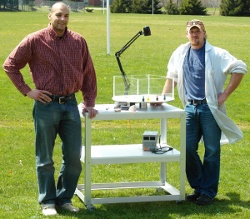
Rotating weather tank. Designed and built with the help of our in-house machinist at StFX, Steven MacDonald! I'm still getting the kinks out but here are some recent movies of my first tests:
balanced flow and Coriolois deflection
,
taylor columns
wordle.net
Projects and Participation
Surface Containment for Carbon Capture and Storage (NRCan Eco-Energy Initiative)
PalEON
: a PaleoEcological Observatory Network reconsturcting ecology and climate over the past 2 millennia (NSF)
ChEAS
Chequamegon Ecosystem-Atmosphere Study
Rocky RACCOON
a Regional Atmospheric Continuous CO
2
Network in the Rocky Mountains
Earth Time
Chronos
: cyberinfrastructure for paleobiological, geochemical, geochronological, lithological, and magnetostratigraphic data (NSF)
NSF REU: Biogeochemistry Research of Extremophiles at the University of the Free State, South Africa
(Summer 2004)
Software Repositories
Basic routines for Fourier analysis of uniform and non-uniform time series
(supplement to "
Earth Sci.'s Guide...
")
Routines for identifying geographically based relationships related to biodiversity using fossil data
(supplement to
Brooks and Cervato, 2010
)
Rapid automated Fourier routines for comparing cycle intensities in model output
(supplement to
Brooks, 2009
)
Bjørn-Gustaf Brooks (
bjorn@geobabble.org
)
Last Modified: Tuesday, 01-Apr-2014 14:07 AST
This page is available at
http://geobabble.org/~bjorn


 Bjørn-Gustaf Brooks (bjorn@geobabble.org)